
15 October 2021 · By Dan Perrin
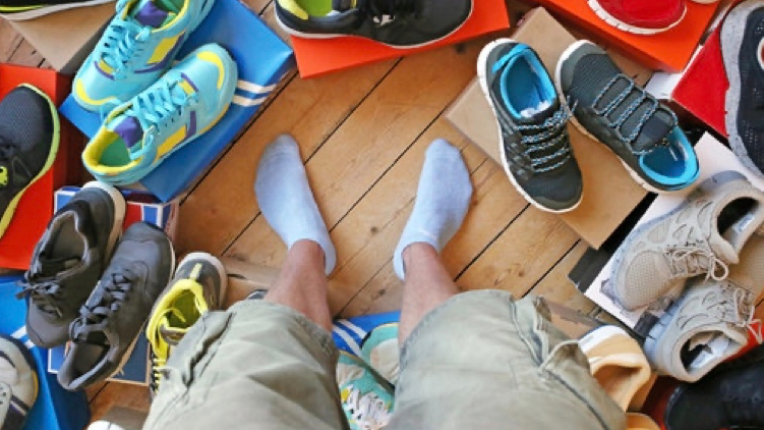
It can be an expensive business choosing running shoes. You look at reviews, read magazines, listen to friends but until you actually run in the shoes you can not tell if they are right for you. There are many different brands and variables to take into account. This short article considers these variables but ultimately will encourage you to try physical shoes on and run in them before you buy.
Cushioning – Cushioning is the reason for road running trainers. It helps protect us from impact injury. As you run, shoe cushioning diminishes and most manufactures estimate 500 miles as a general measure of the lifespan for a standard trainer. Race or lightweight shoes can be as little as 60 to 100 miles. It’s measured by a durometer and is provided in the midsole by two polymers: PU or (polyethylene) or EVA (Ethylene-vinyl acetate) occasionally combined. Firmer shoes are generally more stable but give more impact whilst too much softness can make a shoe less stable. The outsole can be part of the cushion, if you pinch the sole it will often feel harder at the heel than the forefoot. The type and amount of cushioning that is best is subjective.
Fit – A running shoe should fit well. Most people take a running shoe at about half a size bigger than their standard shoes. Brands differ in fit in equivalent sizes and also make shoes in different widths, (from 2A to 4E with B std for Women and D std for Men), and different shapes to fit high arches and flat feet. Try to avoid pinching, bagginess or ruched material, pressure points and stitched seams (old models or cheaper).
Neutral or Stability – When our foot lands it naturally rolls in (pronates) as we roll forward on to the ball of the foot and push off from the big toe. Too much inward rotation is called over-pronation and can cause an injury, especially if it’s a dynamic/snap movement. Stability shoes are designed to reduce or control over pronation. Different brands solve this problem in different ways and some work better for some people than others. It is worth remembering that not enough movement, or under pronation, or excessive outward foot roll (supination) could also cause injury.
Flow- Most people have a gait where the heel or midfoot strikes the ground first then pronates to the forefoot. A progressive, controlled movement from heel to toe is desired. When a shoe is too stiff it can then lead to a stomping style or slapping when running. The result of this can be a reduction in efficiency as it prevents the Achilles tendon doing its job.
Heel drop – This is a measure of how much higher your heel sits in the shoe than your toes. Typically 12 to 8mm is found but in recent years 8 to 4mm is more common, 0mm is available but in niche brands. A slightly higher heel drop can sometimes help if you are prone to calf or Achilles injuries and a lower drop can reduce pronation.
Stack height – This is the height of the outsole, midsole and insole combined. Traditionally 28mm was common as a trainer and 10mm for a racing flat. Nowadays many brands are offering shoes with much higher stack heights. A legal limit in competition road shoes is 40mm.
Plated shoes – The recent marathon world records are a result of the efficiency gain from a 40mm stack, very soft shoe with a forefoot plate made of carbon or nylon plastic. In a competitive race without this style of shoe you’ll be taking a knife to a gunfight, but beware many are quite unstable which doesn’t aid performance and might cause injury. Some models are competition illegal with stack of over 40mm.
Gait Analysis – Gait analysis incorporates much of the above but is often done by videoing and analysing the way the shoes run for an athlete to optimize the right shoe for that athlete’s needs. The pronation, balance (left to right) and flow of the athlete can be evaluated to ensure the best mix of all of the variables. Every runner needs a shoe with good soul…

You may have heard some runners have multiple pairs of shoes in their ‘running shoe rotation’. In truth, it’s not necessary for every runner to have more than one pair of running shoes. If you typically run fewer than four times a week at around the same speed every time, one quality pair of everyday running shoes should do the job. There are, however, some benefits to owning two or more pairs of running shoes. Running injuries are generally caused by repetitive movement and by rotating your shoes, you change your body’s position and minimise the repetitive stress. You may also benefit from using different shoes for different sessions (such as speed sessions) and terrains. If you have shoes for a particular purpose, it also has the benefit of them each lasting longer. Finally, with multiple shoes you have the luxury of choosing your shoes based on how you feel, for example, if you’re feeling tired, you can select a softer, more cushioned shoe.